18/03/2026
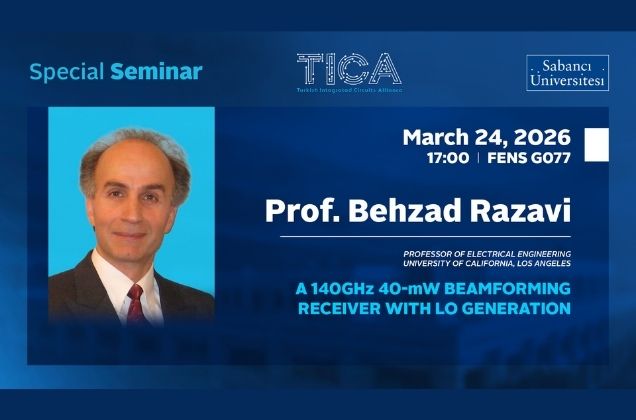
Sabancı University will host Professor Behzad Razavi, one of the world's leading scientists in the field of semiconductor and communication technologies, for a special seminar. Razavi, a faculty member of the Department of Electrical Engineering at UCLA, will discuss high-frequency receiver architectures and low-power design approaches developed for 6G wireless systems.
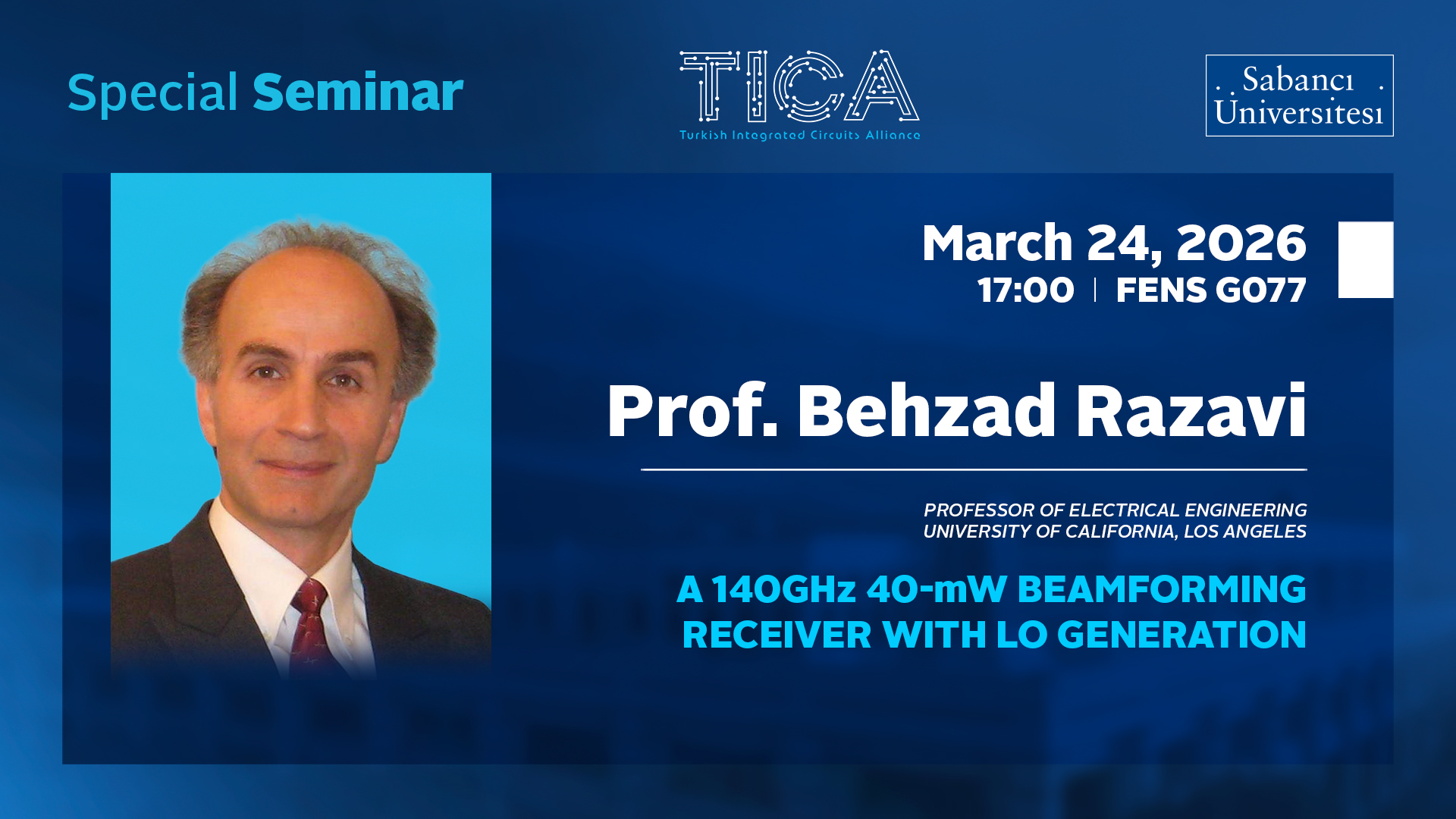
The seminar, organized in collaboration with TICA — Turkish Integrated Circuits Alliance, will be held on Tuesday, March 24, 2026, at 5:00 PM in the FENS G077 hall on Sabancı University Tuzla Campus. The event is open to all interested parties.
Low-power and high-performance receiver designs for 6G
In his seminar, Professor Razavi will focus on low-cost and energy-efficient solutions necessary for the widespread adoption of 6G communication systems in the consumer market. With Wi-Fi 7 aiming for 30 Gbps data speeds, the presentation will highlight the fierce competition among next-generation wireless systems in terms of both performance and power consumption.
The design of a beamforming receiver operating in the 140 GHz frequency band and consuming only 40 mW of power will be described in detail. Thanks to its low noise factor, wide phase shift range, and compact architecture, the developed system offers a significant solution for high-frequency communication applications. The study will also cover new RF architectures, subsampling PLL structures, and innovative phase shifting techniques.
Prof. Dr. Behzad Razavi
Behzad Razavi is Professor of Electrical Engineering at UCLA, where he conducts research on analog and RF integrated circuits. Prof. Razavi has served as an IEEE Distinguished Lecturer and published more than 200 papers and nine books. He has received nine IEEE best paper awards and six teaching and education awards, and his books have been published in seven languages. He received the IEEE Pederson Award in Solid-State Circuits and was recognized as a top author in the 50-year and 75-year histories of the IEEE International Solid-State Circuits Conference. He is a member of the US National Academy of Engineering and a fellow of the US National Academy of Inventors.